Dale Earnhardt Jr. has warned NASCAR that it's likely to see more dramatic brake failures at an upcoming race.
Sunday's Cup Series race at Nashville saw four separate incidents of brake rotors exploding in dramatic fashion on track, sending a car hard into the outside wall every time.
All four of the wrecks happened late in stages, dramatically impacting the course of the race as teams were forced to make snap choices on pit strategy and drivers were given the chance to gain – or lose – places on restarts.
Speaking on his Dale Jr. Download podcast this week, Earnhardt warned that the September race at Gateway will be even harder on the brakes than Nashville, and the problem will arise all over again.
READ MORE: Dale Earnhardt Jr. talks up Cleetus McFarland despite difficult NASCAR outing at Nashville
Dale Jr.: More brakes will fail this year
“Mark this down," he said. "St. Louis, we run the same package. St. Louis is harder on brakes than Nashville. St. Louis, you’re going to have some guys that fail.”
The Cup Series veteran admitted that he was surprised to see the variety of approaches in brake cooling last weekend, revealing: “I was looking at all the teams’ brake ducts, and man, they’re all so different. Typically, everybody’s kind of close.
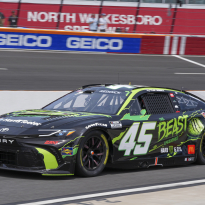
"Guy might have a little more opening than the others, but not vast differences, right? A lot of Fords were sealed solid, a lot of Chevrolets were solid. Seventy-five percent of the garage didn’t have any opening, and then I saw the 45, the 23, the 19, maybe one or two other cars wide open on top.
“So I start talking to some crew chiefs, and they’re like, ‘Nah man, this is how we’re going to run it. We’ve got this rotor, we’ve got this pad, we’ve got this master cylinder, we’re doing this, we’re doing that, and wide open’s the way we want to be'.
"Then there are other people like, ‘Yeah, we can’t get ’em hot enough. We can’t keep the temperature in the rotor'.”
Why did NASCAR Cup Series brakes fail at Nashville?
As Earnhardt went on to explain, it isn't simply a matter of the rotor overheating to breaking point. The actual answer lies in the rapid heating and cooling twice a lap weakening the structural integrity.
“The rotor blows so much air through it that it spikes up to 1,000, 1,200 degrees or whatever," he explained. "You mash the brake, go down in the corner, mash the brake. The temperature rises quickly from, like, 600 to 1,000 degrees. Quick.
"Then you let off, and you go down the next straightaway, and it’s so efficient in cooling the thing cools down 400 to 600 degrees on the next straightaway. Up 400, down 400. Up 400, down 400. Every lap. Twice a lap. Not good. That’s why it cracks.”
NASCAR Today: Denny Hamlin reveals Kyle Busch honor and Ryan Blaney talks controversial penalty